
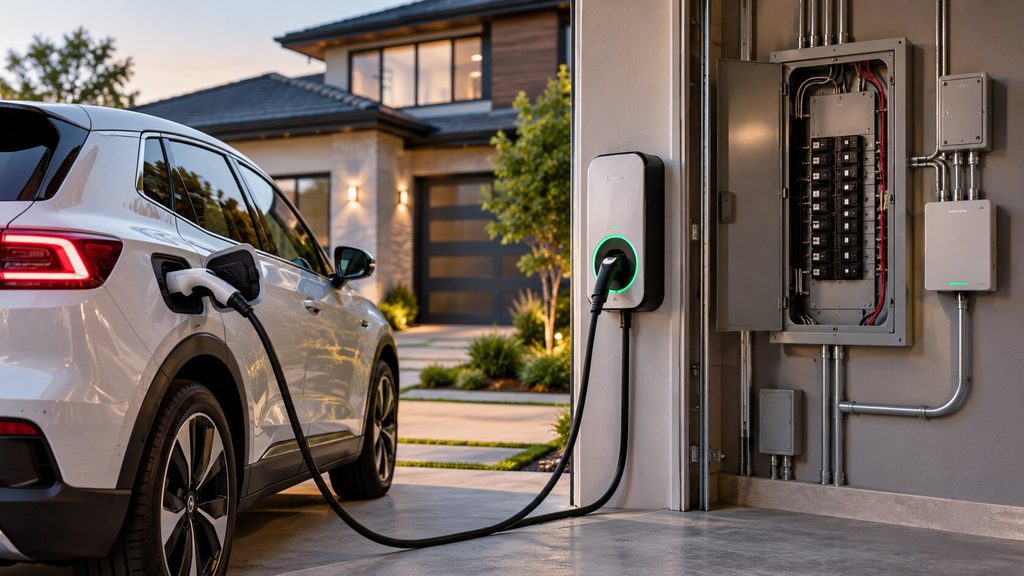
Electric vehicles (EVs) are becoming increasingly common, and more homeowners are installing Level 2 EV chargers at home for faster and more convenient charging. But adding an EV charger can create a challenge for an existing electrical system: Does the home have enough available electrical capacity to support the new load?
In some cases, installing a higher-powered EV charger may require an electrical service upgrade. However, that isn’t always necessary.
EV chargers with built-in load management can help electricians work within the home’s existing electrical capacity by automatically adjusting the charger’s power consumption when other electrical loads are operating.
What Is Electrical Load Management?
Electrical load management is a way of controlling how much electricity an EV charger uses based on the available capacity of the home’s electrical system.
Instead of allowing the EV charger to continuously operate at its maximum output, a load-managed charger can monitor electrical demand and adjust charging power when necessary.
For example, imagine a home with an electric range, HVAC system, water heater, dryer, and other major electrical loads. When several of these appliances are operating at the same time, the home’s electrical demand can increase significantly.
Without load management, adding a high-amperage EV charger could push the system beyond its available capacity.
With load management, the charger can reduce its charging rate during periods of high demand and increase charging power again when other loads decrease.
Why EV Chargers Can Create a Service Upgrade Challenge
An EV charger is considered a significant electrical load because it can operate for several hours at a time.
A typical Level 2 charger may require a dedicated circuit and can draw substantial current while charging. When electricians evaluate an EV charger installation, they need to consider the home’s existing service capacity and the electrical loads already present.
If the calculated demand exceeds what the existing service can safely accommodate, an upgrade may be necessary.
A service upgrade can involve work such as replacing electrical equipment, increasing the service capacity, coordinating with the utility, and potentially modifying other parts of the electrical system.
For homeowners, that can mean additional cost, planning, and installation time.
This is where load management can provide another option.
How Built-In Load Management Works
An EV charger with built-in load management monitors electrical usage and adjusts charging output based on the available capacity.
Think of it as the charger “sharing” the available electrical capacity with the rest of the home.
For example:
- The home has a 200-amp electrical service.
- The HVAC system, oven, dryer, and other appliances are operating.
- The home’s electrical demand increases.
- The EV charger detects that less capacity is available.
- The charger automatically reduces its charging power.
- When other major loads turn off, the charger can increase its charging rate again.
The vehicle continues charging without requiring the charger to operate at its maximum output all the time.
The exact operation depends on the EV charger and load-management system being used.
How Load Management Can Help Avoid a Service Upgrade
One of the biggest advantages of load-managed EV charging is that it can allow an electrician to design an installation around the home’s existing electrical capacity.
Instead of simply adding the EV charger as another large continuous load, the system can actively manage demand.
This can be especially useful in homes where the existing electrical service is adequate for normal household operation but has limited spare capacity for an additional high-demand appliance.
In the right application, load management may help eliminate or postpone the need for a service upgrade.
However, it should never be viewed as a way to simply “work around” an undersized electrical system. The installation still needs to comply with applicable electrical requirements, and the electrician must determine whether the existing service and equipment can safely support the proposed installation.
Load Management Doesn’t Mean “More Power Than the Panel Can Handle”
It’s important to understand what load management does—and doesn’t do.
Load management doesn’t increase the electrical capacity of a home’s service.
Instead, it controls the EV charger’s demand so that total electrical usage remains within the system’s available capacity.
For example, if a home has limited available capacity at a particular moment, the charger may temporarily reduce its charging rate.
The result can be a slower charging session during periods of high household demand, but the vehicle can still receive a useful charge over time.
For many homeowners, this can be a practical trade-off compared with the cost and complexity of upgrading the electrical service.
What Electricians Evaluate Before Recommending Load Management
Before installing an EV charger, an electrician should look at more than just the size of the electrical panel.
A proper evaluation may include:
1. Existing Electrical Service
The electrician determines the home’s service capacity and evaluates whether it is suitable for the proposed EV charging installation.
2. Existing Electrical Loads
Major loads such as HVAC equipment, electric water heaters, ranges, dryers, pools, hot tubs, and other equipment can significantly affect available capacity.
3. EV Charger Requirements
Different EV chargers have different power requirements. The electrician needs to know the charger’s maximum output and electrical requirements.
4. Available Panel Capacity
The condition and configuration of the electrical panel and available breaker spaces are also important considerations.
5. Load Management Compatibility
Not every EV charger or load-management system works the same way. The electrician needs to verify that the selected equipment is appropriate for the home’s electrical system and installation.
A Smarter Approach to EV Charger Installation
For homeowners considering an EV charger, the goal shouldn’t simply be to install the largest charger possible.
The better approach is to find a charging solution that works safely and efficiently with the home’s electrical system.
Load management can give electricians another tool when designing EV charging installations, particularly when a home’s existing service has limited spare capacity.
In some situations, the homeowner may not need a costly service upgrade just to add EV charging. Instead, a properly designed load-management solution can help balance the home’s electrical demand.
Talk to an Electrician Before Installing an EV Charger
Every home is different, and there is no one-size-fits-all answer when it comes to EV charger installations.
Before purchasing a charger or assuming that a service upgrade is required, have a qualified electrician evaluate your home’s electrical system. They can determine the available capacity, review your existing loads, and identify an appropriate charging solution.
Sunderland Electric can help evaluate your electrical system and plan a safe, practical EV charger installation—including solutions that use load management to make better use of your existing electrical capacity. Contact Sunderland Electric to discuss your EV charging needs today.