
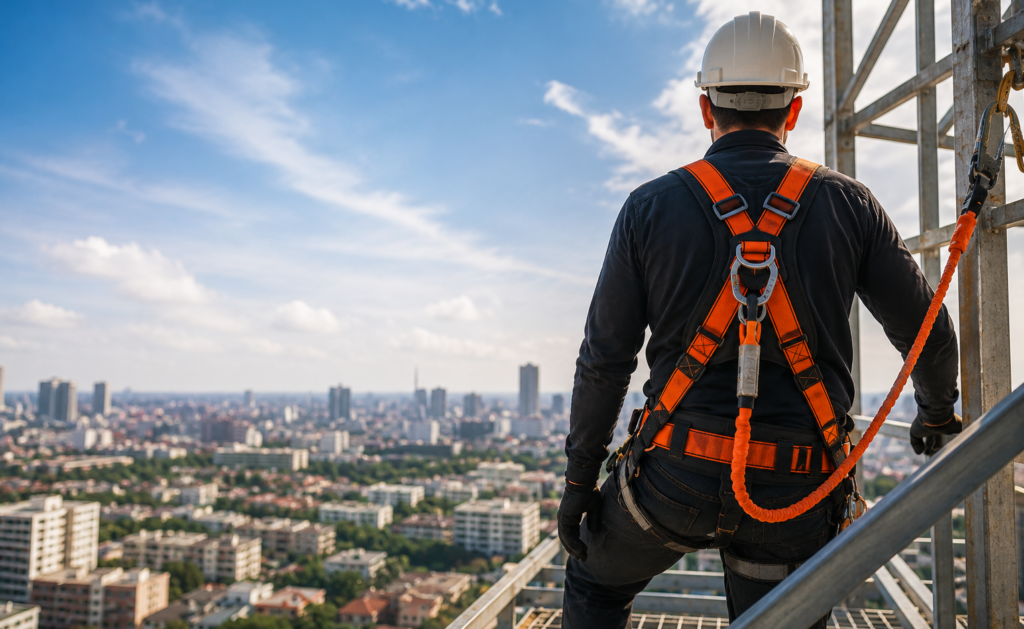
Working at heights is one of the most hazardous tasks across many industries, including construction, maintenance, warehousing, and telecommunications. Falls can lead to serious injuries or fatalities, making height safety a critical workplace priority.
While many incidents are preventable, safe work at height requires more than just wearing a harness. Effective protection depends on proper planning, hazard identification, risk controls, worker training, and the correct use of personal protective equipment (PPE).
Understanding the Risks of Working at Heights
Any task performed at an elevated position where a person could fall and suffer injury qualifies as working at height. This includes:
- Roof work
- Ladder use
- Scaffolding operations
- Tower climbing
- Elevated platform work
- Mezzanine access
- Steel erection
- Window cleaning
- Confined-space vertical entry
- Maintenance activities on elevated machinery
The dangers are often underestimated because many height-related tasks are routine. Workers may become overly familiar with procedures, skip safety checks, or take shortcuts to save time. Unfortunately, routine tasks can quickly become catastrophic when safety measures are ignored.
Common hazards include:
- Unprotected edges
- Fragile roof surfaces
- Unstable ladders
- Improperly erected scaffolding
- Slippery surfaces
- Falling tools and materials
- Weather-related hazards such as wind or rain
- Equipment failure
- Inadequate anchor points
- Human error and fatigue
In many cases, accidents occur not because PPE was unavailable, but because the wrong equipment was selected, incorrectly used, poorly maintained, or bypassed altogether.
The Hierarchy of Controls: Safety Starts Before PPE
One of the most important principles in occupational safety is the hierarchy of controls. PPE is essential, but it should never be the first or only line of defense.
The hierarchy of controls helps organizations reduce risk systematically:
1. Elimination
The safest approach is to eliminate the need to work at height altogether.
Examples include:
- Installing equipment at ground level
- Using extendable tools for inspections
- Prefabricating assemblies on the ground
- Designing buildings with safer maintenance access
If workers do not need to leave the ground, the fall hazard disappears.
2. Substitution
Where elimination is not possible, substitute the task or equipment with safer alternatives.
Examples include:
- Replacing ladders with mobile elevated work platforms (MEWPs)
- Using automated inspection drones
- Installing permanent access systems
3. Engineering Controls
Engineering controls physically isolate workers from hazards.
Examples include:
- Guardrails
- Safety nets
- Fixed walkways
- Toe boards
- Fall arrest anchor systems
- Enclosed platforms
- Scaffolding with proper edge protection
Engineering controls are highly effective because they do not rely solely on worker behavior.
4. Administrative Controls
Administrative controls establish procedures and work practices that reduce exposure to hazards.
These include:
- Permit-to-work systems
- Risk assessments
- Safe work method statements
- Toolbox talks
- Weather monitoring
- Supervisor oversight
- Worker competency training
- Scheduled inspections
- Rescue planning
Administrative controls are crucial for ensuring consistency and accountability.
Personal Protective Equipment (PPE)
PPE serves as the final barrier between workers and injury.
When all other controls cannot fully eliminate the risk, properly selected PPE can significantly reduce the severity of falls or prevent them entirely.
Why PPE Matters So Much in Height Safety
Working at height introduces unique risks because gravity acts instantly. There is little margin for error.
Unlike many workplace hazards, where workers may have time to react, falls often happen suddenly and without warning. PPE, therefore, becomes a life-critical component of the safety system.
Proper PPE for working at heights may include:
- Full-body harnesses
- Shock-absorbing lanyards
- Self-retracting lifelines (SRLs)
- Anchorage connectors
- Safety helmets with chin straps
- Non-slip footwear
- Gloves with grip support
- Eye protection
- High-visibility clothing
- Rescue and descent equipment
However, effective PPE is not just about availability. It must be:
- Correctly selected for the task
- Properly fitted to the worker
- Inspected before use
- Maintained according to manufacturer guidance
- Compatible with other equipment
- Used exactly as intended
Choosing the Right Fall Protection System
Different tasks require different fall protection strategies. Using inappropriate equipment can create additional hazards.
Fall Restraint Systems
Fall restraint systems prevent workers from reaching a fall hazard in the first place.
These systems typically use:
- Harnesses
- Fixed-length lanyards
- Secure anchor points
Because workers cannot physically reach the edge, restraint systems are often safer than arrest systems.
Fall Arrest Systems
Fall arrest systems stop a worker after a fall has occurred.
These systems usually include:
- Full-body harness
- Shock-absorbing lanyard or SRL
- Certified anchor point
A poorly configured fall arrest system can be deadly. Critical considerations include:
- Fall clearance distance
- Swing fall hazards
- Anchor strength
- Equipment compatibility
- Rescue access
Work Positioning Systems
Positioning systems allow workers to maintain stability while working hands-free.
These are common in:
- Tower climbing
- Pole work
- Rope access operations
Workers must still use backup fall protection because positioning systems alone may not arrest a fall.
The Importance of Proper Harness Fit
Even high-quality equipment can fail to protect workers if it does not fit properly.
An improperly fitted harness can:
- Increase injury severity during a fall
- Cause suspension trauma
- Allow workers to slip out
- Restrict movement and create fatigue
- Reduce worker compliance
A correctly fitted harness should:
- Sit snugly without restricting movement
- Position the dorsal D-ring between the shoulder blades
- Keep leg straps secure but comfortable
- Distribute force evenly across the body
Workers should be trained to inspect and adjust harnesses before every use.
Inspection and Maintenance: The Often-Ignored Safety Essential
Damaged or poorly maintained PPE is one of the leading contributors to height-related incidents.
Equipment should always be inspected:
- Before each use
- After impact events
- At scheduled intervals by competent personnel
- According to manufacturer’s requirements
Workers should look for:
- Frayed webbing
- Cuts or burns
- Corrosion
- Broken stitching
- Deformed connectors
- Damaged locking mechanisms
- UV degradation
- Missing labels or certifications
Any defective equipment should be removed from service immediately.
Organizations should also maintain inspection records and establish clear retirement criteria for aging equipment.
Training Is Just as Important as Equipment
Providing PPE without training creates a false sense of security.
Workers must understand:
- Hazard recognition
- Equipment limitations
- Proper fitting procedures
- Anchor selection
- Fall clearance calculations
- Emergency rescue procedures
- Inspection requirements
- Safe climbing techniques
Refresher training is equally important because workers can develop unsafe habits over time.
Practical, scenario-based training often delivers better results than classroom-only instruction.
Rescue Planning: The Critical Missing Piece
Many organizations focus heavily on preventing falls but overlook rescue planning.
A worker suspended in a harness after a fall faces serious risks, including suspension trauma. Rapid rescue is essential.
An effective rescue plan should address:
- Rescue equipment availability
- Communication procedures
- Emergency contacts
- Site access challenges
- Worker retrieval methods
- Rescuer competency
- Medical response procedures
Simply calling emergency services is not always sufficient, especially in remote or elevated environments.
Building a Culture of Height Safety
Safety programs succeed when organizations move beyond compliance and build a genuine culture of prevention.
Strong safety cultures typically include:
- Leadership commitment
- Worker involvement
- Open hazard reporting
- Continuous improvement
- Regular audits
- Clear accountability
- Recognition of safe behavior
Workers are more likely to follow safety procedures when leadership visibly prioritizes safety over speed or production targets.
Supervisors also play a critical role by reinforcing expectations and stopping unsafe practices immediately.
Technology Is Improving Height Safety
Modern technology is helping organizations manage height risks more effectively.
Emerging innovations include:
- Smart harnesses with fall detection
- Wearable safety sensors
- Drone-assisted inspections
- Digital permit systems
- Connected lone-worker monitoring
- AI-assisted hazard recognition
- Advanced self-retracting lifelines
While technology cannot replace strong safety fundamentals, it can enhance visibility, accountability, and emergency response.
Common Mistakes That Increase Risk
Despite widespread awareness, several recurring mistakes continue to contribute to workplace falls.
These include:
- Using damaged PPE
- Connecting to unsuitable anchor points
- Climbing without 100% tie-off
- Overreaching from ladders
- Ignoring weather conditions
- Skipping inspections
- Using incompatible components
- Failing to plan rescues
- Allowing untrained workers to perform elevated tasks
- Rushing work to meet deadlines
Preventing these mistakes requires ongoing vigilance and leadership support.
Working at heights will always involve risks, but those risks can be managed through the right combination of controls, training, and PPE. By prioritizing safety at every stage, organizations can help ensure that every worker returns home safely at the end of the day.
Trust Sunderland Electric for safe, compliant work at heights.